what does my dentistneed to know about my postural ortostatic tacardia syndrome
Postural Orthostatic Tachycardia Syndrome (POTS)
Postural orthostatic tachycardia syndrome (POTS) is a blood circulation disorder characterized by two factors:
-
A specific group of symptoms that frequently occur when standing upright
-
A heart rate increase from horizontal to standing (or as tested on a tilt table) of at least 30 beats per minute in adults, or at least 40 beats per minute in adolescents, measured during the commencement 10 minutes of standing
POTS is diagnosed only when orthostatic hypotension is ruled out and when there is no acute dehydration or blood loss. Orthostatic hypotension is a course of low blood pressure level: 20mm Hg drop in systolic or a 10mm Hg drop in diastolic blood pressure in the first iii minutes of standing upright.
What You Need to Know
- POTS is a common condition affecting an estimated one to three million Americans.
- The symptoms of POTS include but are not limited to lightheadedness (occasionally with fainting), difficulty thinking and concentrating (brain fog), fatigue, intolerance of exercise, headache, blurry vision, palpitations, tremor and nausea.
- Researchers don't fully understand the causes of POTS, merely it is more than common in women than men and is more probable to develop in adolescents and young adults.
- POTS is diagnosed using either a x-minute standing exam or a head-upwards tilt table exam; occasionally other tests are performed to identify specific characteristics of POTS present in some patients.
- Most people'southward POTS symptoms respond to a combination of diet, medications, physical therapy and other treatments.
What is POTS?
POTS is a form of dysautonomia — a disorder of the autonomic nervous organisation. This co-operative of the nervous system regulates functions we don't consciously command, such equally centre rate, claret force per unit area, sweating and trunk temperature. The key characteristics of POTS are the specific symptoms and the exaggerated increase in eye rate when continuing.
What does POTS correspond?
-
Postural: related to the position of your trunk
-
Orthostatic: related to continuing upright
-
Tachycardia: increased heart rate
-
Syndrome: a group of symptoms
Why does heart rate increase excessively with POTS?
In virtually patients with POTS, the structure of the heart itself is normal. POTS symptoms arise from a combination of the following:
-
Lower amount of blood in the apportionment
-
Excessive pooling of blood below the level of the heart when upright
-
Elevated levels of sure hormones such as epinephrine (also known as adrenaline since it is released by the adrenal glands) and norepinephrine (mainly released by fretfulness).
When we stand up, gravity pulls more blood into the lower one-half of the torso. In a good for you person, to ensure that a sufficient amount of blood reaches the encephalon, the body activates several nervous organization responses. Ane such response is releasing hormones that assist tighten claret vessels and cause a small increase in heart rate. This leads to better blood flow to the heart and brain. Once the brain is receiving enough claret and oxygen, these nervous arrangement responses settle back to normal.
In people with POTS, for unclear reasons that may differ from person to person, the blood vessels don't reply efficiently to the indicate to tighten. As a result, the longer you lot are upright, the more blood pools in the lower half of your torso. This leads to not enough blood returning to the brain, which tin be felt as lightheadedness (faintness), brain fog and fatigue. As the nervous arrangement continues to release epinephrine and norepinephrine to tighten the blood vessels, the heart rate increases further. This may cause shakiness, forceful or skipped heartbeats, and breast pain.
Some people with POTS tin develop hypotension (a drop in blood pressure) with prolonged continuing (more iii minutes upright). Others can develop an increment in blood pressure (hypertension) when they stand.
Types and Causes of POTS
The causes of POTS vary from person to person. Researchers don't entirely sympathize the origins of this disorder. The classification of POTS is the subject of discussion, but most government recognize unlike characteristics in POTS, which occur in some patients more others. Importantly, these characteristics are not mutually sectional; person with POTS may experience more of these at the same time:
Neuropathic POTS is a term used to draw POTS associated with harm to the small fiber nerves (small-fiber neuropathy). These nerves regulate the constriction of the blood vessels in the limbs and abdomen.
Hyperadrenergic POTS is a term used to draw POTS associated with elevated levels of the stress hormone norepinephrine.
Hypovolemic POTS is a term used to describe POTS associated with abnormally depression levels of blood (hypovolemia).
Secondary POTS means that POTS is associated with another condition known to potentially cause autonomic neuropathy, such every bit diabetes, Lyme disease, or autoimmune disorders such as lupus or Sjögren'due south syndrome.
What are the symptoms of postural orthostatic tachycardia syndrome?
POTS symptoms vary from person to person and may include:
-
Severe and/or long-lasting fatigue
-
Lightheadedness with prolonged sitting or continuing that can atomic number 82 to fainting
-
Brain fog: trouble focusing, remembering or paying attention
-
Forceful heartbeats or heart palpitations (a feeling of the heart pounding or skipping a shell)
-
Nausea and vomiting
-
Headaches
-
Excessive sweating
-
Shakiness
-
Intolerance of exercise or a prolonged worsening of general symptoms after increased activity
-
A pale face and majestic discoloration of the easily and anxiety if the limbs are lower than the level of the middle
POTS symptoms typically get worse:
-
In warm environments, such as a hot bath or shower, a hot room or on a hot day
-
In situations involving a lot of standing, such as waiting for a motorcoach or when shopping
-
If fluid and salt intake take not been acceptable, such every bit after skipping a meal
POTS symptoms may also get worse when y'all get a mutual cold or an infection. In severe cases, POTS symptoms can prevent a person from beingness upright for more than than a couple of minutes. This can profoundly affect all aspects of personal, school, piece of work and social life.
Although the origin of POTS symptoms is physical, sometimes people attribute the symptoms incorrectly to psychological disorders such as anxiety. While some people with POTS have anxiety disorders similar to the full general population, POTS is non caused by feet.
Tin postural orthostatic tachycardia syndrome be fatal?
While POTS can be life-irresolute, it is not life-threatening. One of the biggest risks for people with POTS is falls due to fainting. Not everyone who has POTS faints. And, for those who practise, it may be a rare consequence. Only, if you don't know that you take POTS, you may not have precautions confronting trauma from falls.
POTS Risk Factors
Dysautonomia International estimates that POTS affects between 1 and three one thousand thousand people in the U.South. The majority of them are women, although men may besides develop POTS. POTS is less common in young children, but it affects adolescents, and symptoms oft develop during puberty. POTS may begin after an apparent or confirmed viral illness, simply it can also appear post-obit surgery and other health events.
POTS can run in families, but no single factor associated with the bulk of cases of POTS has been identified. A mutation in the norepinephrine transporter gene appears to affect only a tiny portion of POTS patients. Amongst genetic factors, there is a strong association between POTS and diverse joint hypermobility disorders, including Ehlers-Danlos syndrome. Recent inquiry has as well highlighted an overlap between POTS, joint hypermobility and mast cell disorders, some of which have a genetic origin.

COVID-19 and POTS: Is At that place a Link?
Although many people recover quickly from COVID-19, the disease acquired by the coronavirus, others who recover may continue to experience symptoms for months. Researchers are nonetheless determining the cause of these extended symptoms, but some COVID-xix "long-haulers" may actually be dealing with POTS.
POTS and Pregnancy
Since POTS affects women of childbearing historic period, a common question is whether having POTS will affect the outcome of the pregnancy. In some studies, slightly more than half of pregnant women with POTS felt better than usual during their pregnancies, which might exist due to the increase in claret volume that is present after the first few weeks of pregnancy. Others had a more variable form, with either stable POTS symptoms or an increment in POTS symptoms. Other complications of pregnancy appear to occur at about the same rate for women with POTS, and their newborns seem to be as good for you as infants born to mothers without POTS.
How is POTS diagnosed?
POTS diagnosis can exist complicated considering the symptoms tin can bear upon a broad range of organ systems, and the most bothersome symptom for each patient may differ. In most instances, symptoms have been present for months before the diagnosis is made. Your doctor will perform a physical test, gild bloodwork and arrange a standing test or a caput-up tilt table test to confirm POTS.
Tilt Table Test for POTS
During the tilt tabular array test, you are secured on a tabular array while lying apartment. Then the table is raised to an almost upright position. Your centre charge per unit, blood pressure and often blood oxygen and exhaled carbon dioxide levels are measured during this examination.
Yous might take POTS if you meet all three of these criteria:
-
Your body produces an aberrant heart charge per unit response to being upright
-
Your symptoms worsen when upright
-
You don't develop orthostatic hypotension in the first three minutes of testing
Other POTS Tests
In some cases, other tests are warranted. They may include:
-
Valsalva maneuver to test the response of the autonomic nerves that control the heart.
-
Quantitative sudomotor axon reflex test (QSART) to measure response of the autonomic nerves responsible for regulating sweating.
-
Although less mutual, your physician may also schedule an MRI and other imaging tests to rule out tumors or other abnormalities.
Similar Conditions
Many conditions share the aforementioned symptoms as POTS. POTS can complicate any other chronic health condition, from asthma to inflammatory bowel affliction. The vast majority of adolescents and young adults with myalgic encephalomyelitis/chronic fatigue syndrome (ME/CFS) accept POTS or related forms of orthostatic intolerance. The intensity of the fatigue, exercise intolerance and other symptoms are greater in those with ME/CFS and POTS than in those with POTS lonely.
Another condition like to POTS is inappropriate sinus tachycardia, in which the resting heart rate is usually above 100 beats per minute. Fibromyalgia patients, those with gastrointestinal motility disorders (such as irritable bowel syndrome), excessive sweating (hyperhidrosis) and many other weather condition can also develop POTS.
How is POTS treated?
Treatment for POTS should be tailored to each private, because the symptoms and underlying atmospheric condition may vary widely. Although in that location is no known cure for POTS, the status tin can exist managed in most patients with nutrition, do and medications.
Postural Orthostatic Tachycardia Syndrome Diet
The foundation of treating POTS is to potable fluids frequently throughout the day. For virtually POTS patients, the goal is at least 64-lxxx ounces (almost 2-2.v liters) a day. You would besides need to increase your intake of salty foods and add together more salt to your diet with a saltshaker or salt tablets. These dietary modifications help keep water in the bloodstream, which helps more blood attain the heart and the brain.
Certain foods or drinks can take an adverse effect on POTS symptoms in some patients. For instance, alcohol well-nigh ever aggravates POTS. Information technology diverts blood away from the cardinal apportionment to the skin and increases loss of fluids through urine. Caffeine can make some people more nervous and lightheaded, but for some it tin can help improve constriction of claret vessels. Your regular md or POTS specialist tin can help you determine how your diet and sure medications could exist helping or hindering your treatment.
Exercise for Postural Orthostatic Tachycardia Syndrome
Physical therapy can brand a departure for some people with POTS. Considering sometimes POTS symptoms can worsen with practice, physical therapy has to start slowly and accelerate based on your tolerance rather than a rigid programme. As your blood circulation improves with medications and diet, the exercise intensity may be gradually increased. The goal is to retrain the autonomic nervous organization to allow for more exercise, which then helps increase the claret volume.
Those who can't stand up upright may start exercising in a horizontal or reclined position. Aquatic therapy may work for some POTS patients due to the water creating pressure around the torso. Many experts find that manual physical therapy that addresses problems with nerve tightness and range of motion works as a bridge to build amend tolerance of practice.
POTS Medications
While no single medication is effective for everyone with POTS, nearly people with frequent symptoms affecting their quality of life demand some grade of medication. The search for the right medication or combination of medications requires patience and persistence on the part of both physicians and patients. These medications may focus on:
-
Improving blood book
-
Helping the kidneys retain sodium (east.g., fludrocortisone)
-
Reducing heart rate or blocking the effect of adrenal hormones on the heart (e.g., beta blockers)
-
Improving blood vessel constriction (east.g., midodrine)
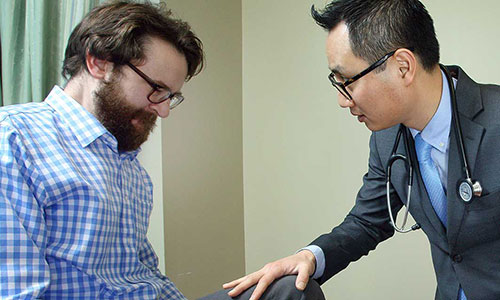
Treatment The Johns Hopkins POTS Program
The POTS program at Johns Hopkins brings together specialists in rehabilitation, cardiology, neurology, concrete therapy and other fields to provide well-rounded treat POTS patients. Our team has developed handling protocols for children and adults with POTS to help you lot effectively manage your symptoms and have more control over this disabling and unpredictable status.
Other POTS Treatments
POTS can also be addressed by modifying your behavior or surround to avoid the worsening of the symptoms. If you know that prolonged sitting, heat or certain drugs make your POTS worse, piece of work with your doctor to minimize these factors.
Wearing pinch garments may help some people reduce excessive blood pooling in the legs. Certain postures while sitting or sleeping may likewise aid reduce POTS symptoms. Some people accept developed habits such every bit standing with legs crossed or sitting in a low chair to compensate for POTS. That's why a tilt tabular array examination is necessary to measure out the body's true response to standing without adaptive habits.
Does postural orthostatic tachycardia syndrome go abroad?
POTS symptoms may spontaneously lessen or disappear for a long fourth dimension. They may come dorsum only as unexpectedly. The absence of symptoms doesn't necessarily mean that the cause of POTS is gone likewise.
Who treats postural orthostatic tachycardia syndrome?
In many cases, your primary intendance physician is qualified to treat POTS. For circuitous POTS cases, it is frequently helpful to have input from a neurologist or cardiologist experienced in this condition. Rehabilitation physicians tin help also in developing an exercise plan that works for you.
Myositis and Neuromuscular Diseases | Q&A with Dr. Tae Chung
Neuromuscular rehabilitation specialist Tae Chung discusses neuromuscular diseases and how they are treated, including with rehabilitation. He also talks about treatment options for myositis and POTS, besides every bit the current research in the field.
Source: https://www.hopkinsmedicine.org/health/conditions-and-diseases/postural-orthostatic-tachycardia-syndrome-pots
0 Response to "what does my dentistneed to know about my postural ortostatic tacardia syndrome"
Post a Comment